

Summary
Explore the Kailash Mansarovar Lake Tour, a sacred pilgrimage and extraordinary Trans-Himalayan adventure in western Tibet. Learn about the spiritual importance of Mount Kailash and Lake Mansarovar in Hinduism, Buddhism, Jainism and the Bon tradition, the challenging 52-km Kailash Kora, Dolma La Pass, Tibetan culture and Lhasa.
The guide also explains the available 12-day, 13-day and 18-day Kailash Mansarovar tours via Lhasa, preparation, best travel season, high-altitude challenges and how to plan a safe and meaningful pilgrimage with local experts from Nepal.
Kailash Mansarovar Lake Tour is a journey to one of the most sacred and remote landscapes in the Himalayas, combining spirituality, pilgrimage, Tibetan culture and high-altitude adventure. Located in western Tibet, Lake Mansarovar and Mount Kailash are revered by Hindus, Buddhists, Jains and followers of the ancient Bon tradition.
For pilgrims, the journey is an opportunity for prayer, devotion, reflection and spiritual renewal. For adventure travellers, it offers an extraordinary experience across the Trans-Himalayan plateau, with vast landscapes, high mountain passes, remote valleys, sacred lakes and the challenging Mount Kailash Kora.
At Nepal Tours Packages, we specialize in tailor-made Himalayan journeys and have more than 25 years of experience in Nepal tourism. Our current Kailash programmes provide Lhasa-based alternatives from Kathmandu, including a 12-day Kailash Mansarovar Yatra, a 13-day Kailash Mansarovar Lake Overland Tour, and a longer 18-day Nepal, Lhasa & Mount Kailash Mansarovar Yatra.
Whether your motivation is religious pilgrimage, spiritual exploration, photography, Himalayan adventure or experiencing one of the world’s most extraordinary landscapes, a carefully planned Kailash Mansarovar Lake Tour can become a journey of a lifetime.
What Is a Kailash Mansarovar Lake Tour?
A Kailash Mansarovar Lake Tour combines a visit to Lake Mansarovar with a pilgrimage to Mount Kailash, usually including the traditional circumambulation of Mount Kailash known as the Kora or Parikrama.
Depending on the itinerary, the journey can also include:
- Kathmandu
- Lhasa
- Gyantse
- Shigatse
- Saga
- Lake Mansarovar
- Darchen
- Mount Kailash
- Dolma La Pass
- Zuthulphuk
- The Tibetan Plateau
Your current Lhasa-based programmes are designed around the changing logistics of travelling from Nepal to Tibet. The 2027 alternatives use Kathmandu–Lhasa air travel before continuing towards western Tibet, rather than depending entirely on the traditional Nepal–Tibet overland route.
This makes the journey more than a simple lake or mountain visit. It is a combination of pilgrimage, cultural exploration, high-altitude trekking and Trans-Himalayan adventure.
Why Is Mount Kailash One of the Holiest Places in the World?
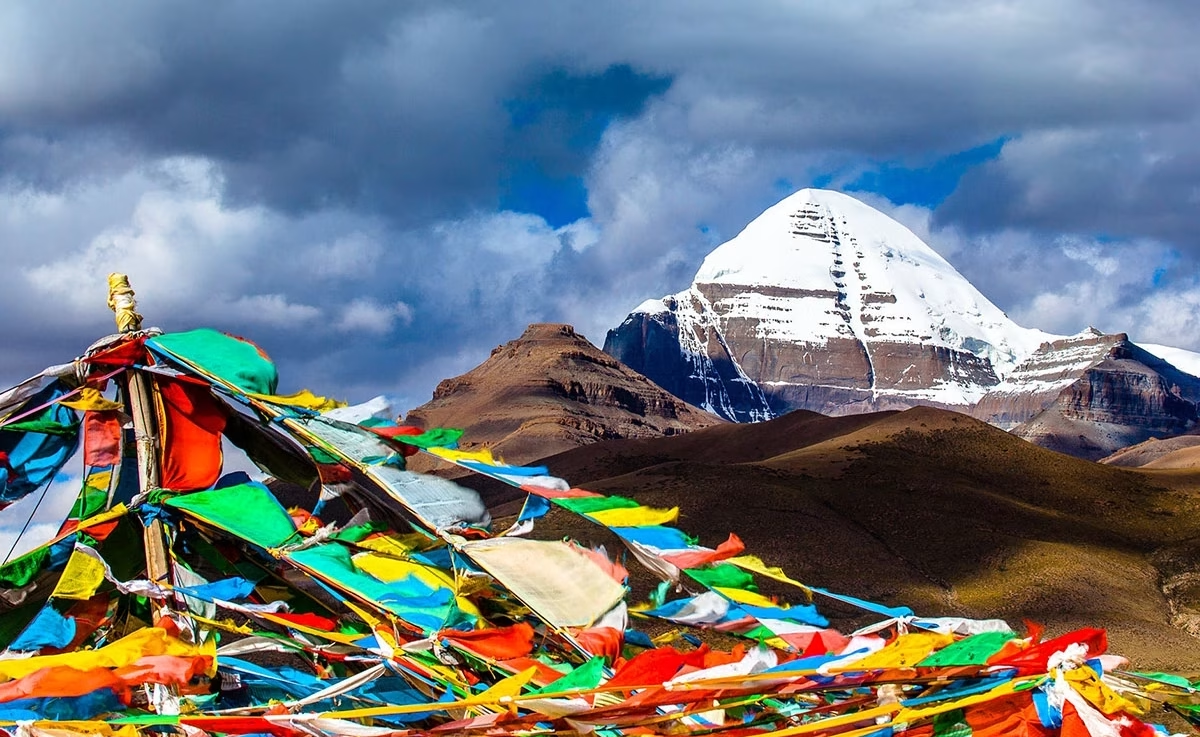
Mount Kailash is one of the world’s most important sacred mountains.
Unlike Mount Everest, where mountaineers attempt to reach the summit, Mount Kailash is traditionally regarded as sacred and is not approached as a climbing objective. Pilgrims instead travel around the mountain as an act of devotion.
The circumambulation is known as:
- Kora in Tibetan Buddhism
- Parikrama in Hindu pilgrimage traditions
- A sacred circumambulation in Jain and Bon traditions
The Kailash Kora is approximately 52 kilometres and normally takes three days on the current itineraries offered by Nepal Tours Packages. The route includes the challenging Dolma La Pass at approximately 5,630 metres.
The extraordinary importance of Mount Kailash comes from the fact that several ancient religious traditions independently regard the mountain and surrounding landscape as sacred.
Mount Kailash in Hinduism
For Hindus, Mount Kailash is traditionally regarded as the abode of Lord Shiva and Goddess Parvati.
The mountain therefore represents a profound spiritual destination associated with meditation, divine presence and liberation.
For many Hindu pilgrims, reaching Mount Kailash and Lake Mansarovar is not simply about seeing a famous Himalayan mountain. The journey itself becomes an act of faith.
Walking the Kailash Parikrama, spending time near Lake Mansarovar and experiencing the remote Himalayan landscape can be deeply personal and devotional.
This is one reason the Kailash Mansarovar Yatra remains one of the most important pilgrimage journeys in the Himalayan region.
Mount Kailash in Buddhism
Mount Kailash also holds deep significance in Tibetan Buddhism.
Buddhist pilgrims undertake the Kora around the mountain while praying and following traditional devotional practices.
The wider region is part of an ancient Tibetan spiritual landscape that includes monasteries, sacred sites, prayer flags, prayer wheels and pilgrimage routes.
Travelling through Lhasa before reaching Kailash adds another dimension to the journey because travellers can experience important Tibetan Buddhist landmarks such as the Jokhang Temple, Barkhor area, Potala Palace and monasteries, subject to local opening and permit arrangements.
Your 12-day Kailash route specifically includes Lhasa sightseeing and acclimatization before travelling overland towards Gyantse, Shigatse, Saga and the Kailash region.
Mount Kailash in Jainism
Mount Kailash is also connected with Jain religious traditions.
The region is associated with Rishabhadeva (Adinath), the first Tirthankara, and with the concept of spiritual liberation.
This adds another important dimension to the religious importance of the Kailash region.
A Kailash Mansarovar Lake Tour is therefore significant because the destination is respected across several ancient traditions rather than belonging to a single religious culture.
Mount Kailash and the Bon Tradition
The indigenous Bon tradition of Tibet also regards the Kailash region as sacred.
Bon has its own religious traditions, cosmology and pilgrimage practices associated with the mountain.
The existence of different traditions around Mount Kailash makes the region one of the world’s most fascinating examples of a living sacred landscape.
For travellers interested in religion, anthropology, history and culture, Kailash provides an opportunity to observe how spirituality and geography have remained interconnected for centuries.
Why Is Lake Mansarovar Sacred?
Lake Mansarovar is an essential part of the Kailash pilgrimage.
Located at high altitude in western Tibet, the lake is surrounded by an immense Trans-Himalayan landscape and is traditionally regarded as sacred by several religious traditions.
For Hindu pilgrims, Lake Mansarovar is associated with important sacred traditions connected with creation and purification.
For Buddhist pilgrims, the lake also has profound spiritual importance.
The combination of:
Mount Kailash + Lake Mansarovar + the surrounding Himalayan landscape
is what makes this region such a powerful pilgrimage destination.
A visit to Lake Mansarovar is therefore not simply a scenic stop on the way to Mount Kailash. It is an important part of the spiritual experience.
Kailash Mansarovar Lake Tour for Spiritual Seekers
A pilgrimage to Kailash is different from an ordinary holiday.
The long journey across the Tibetan Plateau, the high altitude, the physical challenge and the remote environment naturally create an opportunity for reflection.
Many travellers undertake the journey with personal spiritual objectives such as:
- Prayer
- Meditation
- Religious devotion
- Spiritual renewal
- Self-reflection
- Gratitude
- Seeking inner peace
- Completing a lifelong pilgrimage dream
The physical challenge can become part of the spiritual experience.
Walking slowly beneath Mount Kailash, surrounded by enormous Himalayan landscapes, creates an environment very different from everyday life.
Kailash Mansarovar for Adventure Seekers
Although Mount Kailash is primarily a pilgrimage destination, it is also an exceptional destination for adventure travellers.
The Kailash region is located within the remote Trans-Himalayan landscape of western Tibet.
Travellers encounter:
- High-altitude mountain ranges
- Vast Tibetan Plateau landscapes
- Remote valleys
- High-altitude lakes
- Snow-covered peaks
- Mountain passes
- Tibetan settlements
- Monasteries
- Long overland journeys
- High-altitude trekking
The landscape changes dramatically as you travel away from Lhasa.
The green valleys and urban environment gradually give way to enormous open spaces and rugged mountain scenery.
For photographers, hikers and experienced Himalayan travellers, the journey provides a remarkable sense of remoteness.
The Mount Kailash Kora: Where Pilgrimage Meets Adventure
The Mount Kailash Kora is the centrepiece of the Kailash Mansarovar Lake Tour.
Your current Lhasa-based programmes describe the Kora as approximately 52 kilometres over three days.
Day 1: Darchen to Derapuk
The pilgrimage begins near Darchen.
The route gradually enters the Kailash valley and provides increasingly impressive views of Mount Kailash.
The walking pace needs to be slow because of the extreme altitude.
Day 2: Derapuk to Dolma La to Zuthulphuk
This is the most demanding day.
The route climbs towards Dolma La Pass at approximately 5,630 metres before descending towards Zuthulphuk.
Altitude, cold, wind, steep terrain and rapidly changing weather can make this a challenging day.
Day 3: Zuthulphuk to Darchen
The final section completes the sacred circuit.
After reaching the end of the Kora, travellers return to Darchen and continue the onward journey.
Completing the Kora can be both a physical accomplishment and an intensely meaningful spiritual experience.
Why Dolma La Pass Is the Most Challenging Section
Dolma La is the highest point of the Kailash Kora.
At approximately 5,630 metres, it is considerably higher than many famous trekking passes in Nepal.
The challenge is not simply the distance.
At this elevation, oxygen levels are significantly reduced, and even a relatively short climb can feel physically demanding.
Travellers should therefore:
- Acclimatize properly
- Walk slowly
- Stay hydrated
- Follow the guide’s instructions
- Carry suitable warm clothing
- Avoid rushing
- Be prepared for changing weather
- Understand their own physical limitations
The Kora should be treated as a serious high-altitude pilgrimage rather than an ordinary sightseeing walk.
The Trans-Himalayan Landscape Around Kailash
One of the most memorable aspects of a Kailash Mansarovar Lake Tour is the landscape.
The western Tibetan Plateau is very different from the lush valleys commonly associated with Nepal.
Here, travellers encounter:
- Dry mountain valleys
- Vast open plains
- High-altitude lakes
- Rugged mountain ranges
- Snow-covered summits
- Remote settlements
- Wide Himalayan skies
- Dramatic light and shadows
The feeling of remoteness is part of the adventure.
For travellers who want to experience a less-developed and less-commercialized Himalayan environment, Kailash offers something very different from conventional trekking destinations.
Lhasa: The Cultural Gateway to Kailash
A Lhasa-based Kailash Mansarovar Lake Tour adds an important cultural dimension to the pilgrimage.
Lhasa allows travellers to experience Tibetan Buddhist heritage before continuing towards western Tibet.
Depending on permits, local regulations and opening arrangements, sightseeing can include:
Jokhang Temple
The spiritual centre of Lhasa and one of Tibet’s most important Buddhist pilgrimage sites.
Barkhor
The historic area surrounding Jokhang Temple, where pilgrims and visitors experience the traditional atmosphere of old Lhasa.
Potala Palace
One of Tibet’s most recognizable landmarks and a major symbol of Tibetan history and culture.
Sera and Drepung Monasteries
Important Tibetan Buddhist monasteries that can add valuable cultural context to the Kailash journey.
Your current itineraries allow time in Lhasa for both sightseeing and acclimatization before continuing towards the Kailash region.
Why Choose a Lhasa Route for Kailash Mansarovar?
For travellers planning Kailash Mansarovar Yatra 2027, the Lhasa route provides an important alternative.
Following the major disruption along sections of the Nepal–Tibet border in 2026, the future operating status of the traditional Kerung–Gyirong route remains subject to changing conditions.
Your 2027 programme therefore offers Lhasa-based alternatives using air travel from Kathmandu to Lhasa before continuing towards Kailash.
This approach provides several advantages:
Air access from Kathmandu
Fly from Kathmandu to Lhasa instead of depending entirely on a land border crossing.
Lhasa acclimatization
Spend time in Lhasa before reaching the much higher Kailash region.
Tibetan cultural experience
Experience Lhasa, Gyantse, Shigatse and other important locations.
Alternative route planning
The journey does not depend entirely on the reopening of one particular Nepal–Tibet land crossing.
Flexible options
Travellers can choose between a shorter 12-day programme, a 13-day overland return, or a longer 18-day Nepal–Lhasa–Kailash experience.
Kailash Mansarovar Yatra 2027: Current Route Options
Nepal Tours Packages currently provides several ways to plan the journey.
12-Day Kailash Mansarovar Yatra via Lhasa
The 12-day Kailash Mansarovar Yatra via Lhasa from Kathmandu is designed for travellers seeking a relatively shorter route.
The journey follows:
Kathmandu → Lhasa → Gyantse → Shigatse → Saga → Lake Mansarovar → Darchen → Kailash Kora → Purang → Lhasa → Kathmandu
The current advertised price is USD 3,550 per person, based on a minimum of six travellers and twin-sharing accommodation. The proposed 2027 season is approximately mid-April to mid-October, subject to permits, flights and operating conditions.
Explore the 12-Day Kailash Mansarovar Yatra via Lhasa from Kathmandu.
13-Day Kailash Mansarovar Lake Overland Tour
The 13-day Kailash Mansarovar Lake Overland Tour from Lhasa is particularly suitable for travellers who want more of the Tibetan Plateau experience by road.
The route travels from the Kailash region back through Saga and Shigatse to Lhasa, followed by the flight from Lhasa to Kathmandu.
The current advertised price is USD 3,350 per person, based on six travellers and twin-sharing accommodation.
Explore the 13-Day Kailash Mansarovar Lake Overland Tour from Lhasa.
18-Day Nepal, Lhasa & Mount Kailash Mansarovar Yatra
For travellers with more time, the 18-day Nepal, Lhasa & Mount Kailash Mansarovar Yatra combines Nepal’s cultural and Himalayan highlights with Lhasa and the Kailash pilgrimage.
The itinerary includes Kathmandu, Pokhara, the Annapurna foothills, Lhasa, Lake Mansarovar and the three-day Kailash Kora.
Explore the 18-Day Nepal, Lhasa & Mount Kailash Mansarovar Yatra.
Which Kailash Mansarovar Route Is Right for You?
Choosing the right route depends on your available time, preferred travel style and interest in overland adventure.
| Route | Best For | Main Feature |
|---|---|---|
| 12 Days | Time-conscious pilgrims | Shorter Lhasa-based alternative |
| 13 Days | Adventure travellers | More overland travel through Tibet |
| 18 Days | Travellers wanting a comprehensive experience | Nepal + Pokhara + Lhasa + Kailash |
If your priority is the pilgrimage itself and you have limited time, the 12-day option may be appropriate.
If you want to experience more of the Tibetan Plateau by road, the 13-day itinerary provides a stronger adventure element.
If you want to combine Nepal’s cultural and Himalayan highlights with Kailash, the 18-day itinerary provides the most comprehensive experience.
Best Time for a Kailash Mansarovar Lake Tour
The proposed operating season for the current Lhasa-based 2027 itineraries is approximately mid-April to mid-October, subject to Tibet travel permits, government approvals, road conditions, accommodation, transportation and flight schedules.
Because Kailash is an extremely high-altitude destination, conditions can change quickly.
Therefore, the exact departure date should be confirmed based on the latest operational information rather than relying solely on a fixed seasonal assumption.
For travellers considering 2027, our dedicated guide provides a useful overview:
Kailash Mansarovar Yatra 2027 – Alternative Route via Lhasa
Is Kailash Mansarovar Suitable for Everyone?
A Kailash Mansarovar Lake Tour is physically demanding.
The journey involves high altitude, long road transfers and a demanding three-day Kora.
The most challenging factors include:
- High altitude
- Reduced oxygen
- Cold temperatures
- Steep terrain
- Long walking days
- Remote accommodation
- Changing weather
- Limited medical facilities in remote areas
The Kailash Kora should therefore not be compared with an easy sightseeing excursion.
Travellers should prepare physically before departure and consult an appropriate medical professional about high-altitude travel if they have any health concerns.
Travel insurance covering the relevant high-altitude activities and emergency arrangements should also be considered.
How to Prepare for a Kailash Mansarovar Lake Tour
Preparation can make a significant difference.
Build walking fitness
Regular walking and uphill training before departure can help.
Prepare for altitude
Understand that fitness alone does not guarantee immunity from altitude-related problems.
Pack properly
Warm layers, waterproof outerwear, good walking shoes, sunglasses, sunscreen, gloves, a hat and personal medication are essential considerations.
Stay hydrated
Hydration is particularly important at high altitude.
Walk slowly
The objective is not speed. The Kora should be completed steadily and safely.
Allow flexibility
Weather, permits and transportation can affect Himalayan travel.
Our itineraries therefore include acclimatization and, where appropriate, buffer arrangements.
Why Book Your Kailash Mansarovar Lake Tour with Nepal Tours Packages?
A Kailash pilgrimage requires careful coordination.
It is not simply a matter of booking a hotel and transportation.
The journey involves:
- Nepal arrangements
- Tibet permits
- Transportation
- Accommodation
- Local guides
- High-altitude logistics
- Kailash Kora support
- Flight coordination
- Route planning
- Contingency arrangements
At Nepal Tours Packages, our approach is based on more than 25 years of tourism experience in Nepal and practical knowledge of Himalayan travel.
We coordinate the Nepal side of the journey and work with our Tibet partners for the Tibet and Kailash sections.
Our focus is on:
Local expertise + personalized planning + transparent communication + practical logistics + responsible Himalayan travel.
We do not believe every traveller should follow exactly the same itinerary.
Your Kailash journey can be discussed around your available time, preferred route, group size and travel objectives.
Experience Kailash as a Pilgrimage, Not Just a Tour
The true meaning of a Kailash Mansarovar Lake Tour is difficult to describe in terms of sightseeing alone.
It is the combination of:
Faith.
Landscape.
Adventure.
Culture.
Physical challenge.
Reflection.
Pilgrimage.
Standing beside Lake Mansarovar, looking towards the sacred mountains, and later walking the ancient Kora beneath Mount Kailash can become one of the most powerful experiences of a lifetime.
For religious pilgrims, it may represent the fulfilment of a lifelong spiritual aspiration.
For adventure travellers, it offers an extraordinary journey into the remote Trans-Himalayan wilderness.
For cultural travellers, it provides a rare opportunity to experience the living traditions of Tibet.
And for anyone seeking something beyond an ordinary holiday, Kailash offers a journey that combines the physical and spiritual dimensions of travel.
Plan Your Kailash Mansarovar Lake Tour
If Mount Kailash and Lake Mansarovar have been on your pilgrimage or travel list, 2027 is an excellent time to begin planning.
Our current Lhasa-based routes provide alternatives for travellers who want to combine Kathmandu, Lhasa, the Tibetan Plateau, Lake Mansarovar and the Mount Kailash Kora.
You can choose from:
12-Day Kailash Mansarovar Yatra via Lhasa
13-Day Kailash Mansarovar Lake Overland Tour
18-Day Nepal, Lhasa & Mount Kailash Mansarovar Yatra
The exact route, departure date, permits, flights and operating conditions should be confirmed before booking because Tibet travel arrangements can change.
Ready to Begin Your Kailash Journey?
Contact Nepal Tours Packages to Plan Your Kailash Mansarovar Lake Tour
Tell us:
- Your preferred travel month
- Number of travellers
- Nationality
- Preferred 12-, 13- or 18-day route
- Whether your priority is pilgrimage, spirituality or adventure
- Any Nepal or Tibet extensions you would like
Our team will then help you develop a practical and personalized itinerary.
Kailash is not simply a destination to reach. It is a journey to experience.
Frequently Asked Questions About Kailash Mansarovar Lake Tour
What is a Kailash Mansarovar Lake Tour?
A Kailash Mansarovar Lake Tour is a pilgrimage and high-altitude journey to sacred Lake Mansarovar and Mount Kailash in western Tibet, usually including the Mount Kailash Kora or Parikrama.
Why is Mount Kailash sacred?
Mount Kailash is revered by Hinduism, Buddhism, Jainism and the Bon tradition. Each tradition has its own spiritual beliefs and pilgrimage practices associated with the mountain.
Why is Lake Mansarovar important?
Lake Mansarovar is one of the most sacred lakes in the Himalayan region and has deep religious significance for several traditions, particularly Hinduism and Buddhism.
How long is the Kailash Kora?
The current Kailash itineraries offered by Nepal Tours Packages describe the Kora as approximately 52 kilometres over three days, including the crossing of Dolma La Pass at approximately 5,630 metres.
Is Kailash Mansarovar a trek or pilgrimage?
It is both. The primary purpose for many travellers is pilgrimage, while the Kora itself involves demanding high-altitude walking. Adventure travellers can also appreciate the Trans-Himalayan landscape and physical challenge.
Can I travel to Kailash from Nepal via Lhasa?
Yes. Nepal Tours Packages currently offers Lhasa-based alternatives that begin with a Kathmandu–Lhasa flight before continuing towards Mount Kailash and Lake Mansarovar.
Is Kailash Mansarovar Yatra available in 2027?
The current Lhasa-based programmes are planned for the 2027 season, approximately mid-April to mid-October, subject to Tibet permits, government approvals, transportation, road conditions and flight schedules.
What is the difference between the 12-day and 13-day Kailash tours?
The 12-day itinerary is designed as a shorter Lhasa-based alternative, while the 13-day programme provides a more extensive overland return from the Kailash region through Saga and Shigatse to Lhasa before flying to Kathmandu.
Is the Kailash Kora difficult?
Yes. The combination of altitude, steep terrain, weather and long walking days makes the Kora physically demanding. The crossing of Dolma La is generally the most challenging section.
How can I start planning my Kailash Mansarovar Lake Tour?
Start by choosing your preferred month, route and group size. Then contact Nepal Tours Packages for current Tibet travel conditions, permits, flights, availability and a personalized itinerary.
