

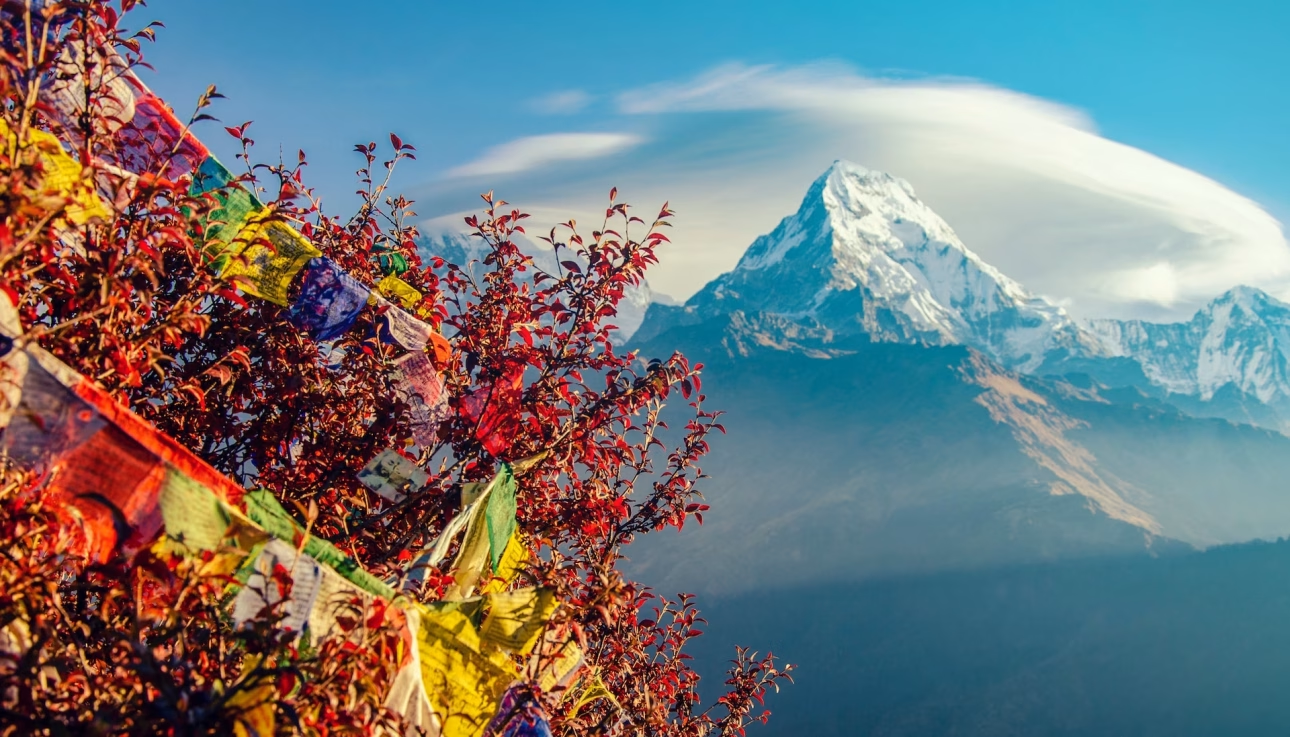
Summary
Discover the best 14-day Nepal itinerary for first-time Australian travellers, combining Kathmandu's UNESCO heritage, Pokhara's Himalayan scenery, a gentle Annapurna foothills trek, and Chitwan's wildlife. The itinerary balances culture, nature, adventure, local experiences and relaxation for a comfortable and memorable first trip to Nepal.
What is the best Nepal itinerary for an Australian traveller visiting Nepal for the first time and looking for the perfect two-week holiday?
This is an important question to consider when planning a Nepal tour from Australia. After making the long journey to Nepal, you naturally want to make the most of your time—but that does not mean trying to see every part of the country in just 14 days.
With a thoughtfully planned two-week itinerary, you can experience far more than Kathmandu. You can explore ancient temples and UNESCO World Heritage Sites, see spectacular Himalayan scenery from Pokhara, walk through traditional mountain villages, experience the Annapurna foothills and finish your journey with a wildlife safari in Chitwan National Park.
For first-time visitors, the key is not trying to see everything. A good Nepal itinerary should bring together different experiences while avoiding unnecessary long journeys, constant hotel changes and an exhausting pace.
This is particularly important for Australian travellers. After a long international journey, a well-paced 14-day Nepal holiday should give you time to enjoy the country rather than feel that you are constantly travelling to the next destination.
The ideal itinerary should combine culture, Himalayan scenery, gentle trekking, local experiences, wildlife and relaxation—creating a varied holiday without turning it into a race.
So, what should you include in your first two weeks in Nepal?
For many Australian travellers, the answer is a carefully balanced combination of Kathmandu, Pokhara, the Annapurna foothills and Chitwan National Park.
This route allows you to experience four very different sides of Nepal:
Kathmandu – Culture & Heritage
Discover ancient Hindu and Buddhist sites, UNESCO World Heritage Sites, historic royal cities and the living traditions of the Kathmandu Valley.
Pokhara – Lakes & Himalayan Panorama
Relax beside Phewa Lake while enjoying spectacular views towards the Annapurna and Machhapuchhre ranges.
Annapurna Foothills – Mountains & Local Life
Walk through forests, terraced farmland and traditional Himalayan villages while experiencing the mountains at a comfortable pace.
Chitwan – Wildlife & Nature
Finish your journey in the subtropical lowlands with jungle activities, wildlife encounters, river experiences and an introduction to Tharu culture.
Together, these destinations create a complete introduction to Nepal in 14 days.
This guide explains how to make the most of two weeks in Nepal, why this combination works particularly well for first-time Australian visitors, and how to balance sightseeing, Himalayan walking, wildlife and relaxation without spending too much of your holiday on the road.
The goal is simple: not to see all of Nepal, but to experience the very best of Nepal at a comfortable and rewarding pace.
Is 14 Days Enough for Nepal?
Yes.
In fact, 14 days is one of the best lengths for a first Nepal holiday.
A week allows you to see Kathmandu and Pokhara, but the trip can feel rushed if you also want to experience the mountains and wildlife.
With two weeks, you can slow down and experience several completely different sides of Nepal.
A well-balanced 14-day Nepal itinerary can include:
- Kathmandu’s ancient heritage
- Buddhist and Hindu culture
- Himalayan mountain views
- Pokhara and Phewa Lake
- A short Annapurna foothills trek
- Traditional Gurung villages
- Chitwan National Park
- Jungle safari
- Tharu culture
- Time to relax and shop
The result is much more than a sightseeing tour.
It becomes a genuine introduction to Nepal.
Best Nepal Itinerary: A Perfect 14-Day First Trip for Australian Travellers
What is the best Nepal itinerary for an Australian traveller visiting Nepal for the first time and looking for the perfect two-week holiday?
This is an important question to consider when planning a Nepal tour from Australia. After making the long journey to Nepal, you naturally want to make the most of your time—but that does not mean trying to see every part of the country in just 14 days.
With a thoughtfully planned two-week itinerary, you can experience far more than Kathmandu. You can explore ancient temples and UNESCO World Heritage Sites, see spectacular Himalayan scenery from Pokhara, walk through traditional mountain villages, experience the Annapurna foothills and finish your journey with a wildlife safari in Chitwan National Park.
For first-time visitors, the key is not trying to see everything. The best Nepal itinerary combines different experiences without spending too much of your holiday sitting in a vehicle, changing hotels or rushing from one destination to another.
This is particularly important for Australian travellers. After travelling such a long distance, a well-paced 14-day Nepal holiday should give you time to enjoy the country rather than feel that you are constantly travelling to the next destination.
The ideal itinerary should combine culture, Himalayan scenery, gentle trekking, local experiences, wildlife and relaxation—creating a varied holiday without turning it into a race.
So, What Is the Best 14-Day Nepal Itinerary?
For a first-time Australian visitor, we recommend a carefully balanced route:
Kathmandu → Pokhara → Annapurna Foothills → Pokhara → Chitwan → Kathmandu
This combination allows you to experience four very different sides of Nepal:
- Kathmandu: ancient culture, Hindu and Buddhist heritage and UNESCO World Heritage Sites
- Pokhara: Phewa Lake, Himalayan scenery and relaxation
- Annapurna Foothills: gentle Himalayan walking, Gurung villages and mountain panoramas
- Chitwan: jungle safari, rhinoceros, birdlife and Tharu culture
The important point is that this is not a high-altitude expedition. The Annapurna section is deliberately designed as a gentle Himalayan walking experience, with overnight stays in comfortable mountain lodges and maximum altitude of around 2,012 metres at Ghandruk.
That makes this route particularly attractive to first-time visitors who want to experience the Himalayas without committing their entire holiday to a demanding trek.
14-Day Nepal Itinerary at a Glance
| Day | Destination | Main Experience | Max. Altitude |
|---|---|---|---|
| 1 | Kathmandu | Arrival & relaxation | 1,400m |
| 2 | Kathmandu | 4 UNESCO World Heritage Sites | 1,400m |
| 3 | Pokhara | Scenic flight & sightseeing | 822m |
| 4 | Birethanti | Begin Annapurna foothills trek | 1,025m |
| 5 | Ghandruk | Gurung village & Himalayan views | 2,012m |
| 6 | Landruk | Forests, villages & mountain scenery | 2,012m* |
| 7 | Majgaon | Peaceful Himalayan villages | 1,565m* |
| 8 | Dhampus | Annapurna panorama | 1,525m |
| 9 | Pokhara | Trek conclusion & relaxation | 1,525m* |
| 10 | Pokhara | Leisure / optional activities | 822m |
| 11 | Chitwan | Jungle & Tharu culture | 415m |
| 12 | Chitwan | Jeep safari & canoe ride | 415m |
| 13 | Kathmandu | Flight & free time | 1,400m |
| 14 | Kathmandu | Departure | 1,400m |
*Maximum altitude figures should be checked against your final trekking route, as some supplied figures appear to describe the previous overnight elevation rather than the day’s destination.
Day 1 – Arrival in Kathmandu
Your Nepal adventure begins in Kathmandu at approximately 1,400 metres.
After your international flight from Australia, you will be warmly welcomed at Tribhuvan International Airport and transferred by private vehicle to your comfortable hotel.
The journey into Kathmandu gives you your first glimpse of Nepal: colourful prayer flags, temples, busy streets, local markets, cafés and the distinctive atmosphere of the Kathmandu Valley.
After checking into your hotel, keep the first day relaxed.
You can simply rest after your long journey or take a gentle walk around Thamel.
Why this day matters
Australian travellers have already spent many hours travelling before arriving in Nepal. Starting slowly gives you time to recover and prepares you for the active days ahead.
Driving: approx. 6 km
Transfer: 30–45 minutes
Altitude: 1,400m
Meals: Not included
Accommodation: Comfort hotel in Kathmandu
Day 2 – Discover Four UNESCO World Heritage Sites in Kathmandu
Today introduces you to the cultural heart of Nepal.
Rather than spending your first full day simply walking around Kathmandu, this itinerary brings together four major heritage sites:
Pashupatinath Temple
One of Nepal’s most important Hindu temples, situated beside the sacred Bagmati River.
Boudhanath Stupa
One of the world’s great Buddhist monuments and an important centre of Tibetan Buddhist culture.
Swayambhunath Stupa
Known as the Monkey Temple, this hilltop complex provides impressive views across Kathmandu Valley.
Patan Durbar Square
A masterpiece of Newari architecture, famous for its temples, courtyards, palace buildings and traditional craftsmanship.
This is much more than a sightseeing day.
It gives you an introduction to Nepal’s Hindu and Buddhist traditions, architecture, history and living culture before you head towards the mountains.
Driving: approx. 25 km
Sightseeing duration: 5–6 hours
Altitude: 1,400m
Meals: Breakfast
Accommodation: Comfort hotel in Kathmandu
Day 3 – Fly to Pokhara & Discover the City of Lakes
After breakfast, transfer to Kathmandu Airport for the short flight to Pokhara.
The flight takes approximately 25 minutes, but it can provide spectacular Himalayan views when weather conditions are clear.
Pokhara sits at approximately 822 metres, making it considerably lower than Kathmandu.
After arriving, explore some of the city’s highlights, including:
- Bindhyabasini Temple
- Seti River Gorge
- Devi’s Falls
- Gupteshwor Cave
- Phewa Lake
A boat ride on Phewa Lake is particularly enjoyable in the afternoon.
On a clear day, Machhapuchhre—Fishtail Mountain—rises dramatically above the lake.
This is an important feature of the itinerary: after the cultural intensity of Kathmandu, you have time to slow down beside the lake before beginning your Himalayan walk.
Flight: approx. 25 minutes
Driving: approx. 15 km / 1 hour
Altitude: 822m
Meals: Breakfast
Accommodation: Comfort hotel in Pokhara
Day 4 – Begin the Annapurna Foothills Trek: Nayapul to Birethanti
Now the adventure begins.
After breakfast, drive from Pokhara to Nayapul, the starting point for your gentle Annapurna foothills trek.
The walking route takes you through:
- Traditional villages
- Terraced farmland
- Forests
- River valleys
- Suspension bridges
- Rural communities
The walking distance is approximately 9 km, taking around 3–4 hours.
The purpose of this first trekking day is not to push yourself.
It is to gradually transition from sightseeing to Himalayan walking.
You spend the night in Birethanti at approximately 1,025m, in a comfortable mountain lodge.
Drive: approx. 42 km / 1.5 hours
Walk: approx. 9 km / 3–4 hours
Altitude: 1,025m
Meals: Breakfast, lunch & dinner
Accommodation: Mountain lodge
Day 5 – Birethanti to Ghandruk
Today is one of the highlights of the entire journey.
The trail gradually climbs through forests, farmland and traditional settlements towards Ghandruk at approximately 2,012m.
Ghandruk is one of the best-known Gurung villages in the Annapurna region.
Along the way you encounter:
- Terraced fields
- Stone houses
- Suspension bridges
- Rhododendron forests
- Mountain streams
- Traditional villages
The approximately 11 km / 5-hour walk is moderate but rewarding.
From Ghandruk, the mountain panorama becomes much more impressive, with views towards Annapurna South, Hiunchuli and Machhapuchhre.
You can explore the village in the afternoon and, if interested, visit the Gurung Cultural Museum.
Walking: approx. 11 km / 5 hours
Altitude: 2,012m
Meals: Breakfast, lunch & dinner
Accommodation: Comfort mountain lodge
Why Ghandruk is important
This is where the itinerary moves beyond simply seeing the Himalayas.
You are now experiencing Himalayan village life.
Day 6 – Ghandruk to Landruk
Wake early if the weather is clear for a Himalayan sunrise.
The trail then descends through forests towards the Modi Khola Valley before crossing a suspension bridge and continuing towards Landruk, another traditional Gurung settlement.
The walk is approximately 8 km and around 4 hours.
This is a quieter section of the Annapurna foothills, allowing you to experience rural Nepal away from the busier trekking routes.
You will see farmers working terraced fields and experience the slower rhythm of mountain life.
Walking: approx. 8 km / 4 hours
Altitude: approx. 1,565m at Landruk
Meals: Breakfast, lunch & dinner
Accommodation: Comfort mountain lodge
Day 7 – Landruk to Majgaon
Continue through peaceful forests, cultivated farmland and small Himalayan communities.
At approximately 11 km and 4 hours, this is another manageable walking day.
The route provides a wonderful mixture of:
- Forest
- Farmland
- Villages
- Mountain views
- Local interaction
Rather than rushing through the villages, your guide can help you understand local farming, architecture and everyday life.
Walking: approx. 11 km / 4 hours
Altitude: approx. 1,400–1,565m, depending on the final route
Meals: Breakfast, lunch & dinner
Accommodation: Comfort mountain lodge
Day 8 – Majgaon to Dhampus
Your final full trekking day takes you towards Dhampus, one of the most attractive viewpoints in the Annapurna foothills.
The approximately 12 km / 4-hour walk passes through villages such as Patlekhet and Pothana.
As the trail reaches Dhampus, the landscape opens up dramatically.
On clear days you can enjoy panoramic Himalayan views including:
- Annapurna South
- Hiunchuli
- Machhapuchhre
- Lamjung Himal
- Dhaulagiri
The evening provides an opportunity to enjoy the sunset over the mountains.
Walking: approx. 12 km / 4 hours
Altitude: 1,525m
Meals: Breakfast, lunch & dinner
Accommodation: Comfort mountain lodge
Day 9 – Dhampus to Phedi & Return to Pokhara
After breakfast, make the final descent towards Phedi.
This is a short walking day of approximately 4 km / 1.5 hours.
Your private vehicle will meet you at Phedi for the return drive to Pokhara.
After several days of walking, the afternoon is deliberately free.
You can enjoy:
- A massage
- Phewa Lake
- Lakeside cafés
- Shopping
- Relaxation at your hotel
This transition is important.
You have just completed a genuine Himalayan walking experience, but you do not immediately move into another demanding activity.
Walking: approx. 4 km / 1.5 hours
Drive: approx. 20 km / 45 minutes
Meals: Breakfast
Accommodation: Comfort hotel in Pokhara
Day 10 – Relaxing Day in Pokhara
A free day in Pokhara gives you the flexibility that is often missing from tightly packed Nepal itineraries.
You can simply relax or choose an optional experience.
Popular choices include:
- Sarangkot sunrise
- Paragliding
- Boating
- Mountain biking
- Ziplining
- Spa and massage
- Yoga
- Exploring Lakeside
For Australian travellers, this free day is especially valuable after the trekking section.
It prevents the holiday from becoming physically exhausting.
Altitude: 822m
Meals: Breakfast
Accommodation: Comfort hotel in Pokhara
Day 11 – Pokhara to Chitwan National Park
The scenery changes dramatically today.
Leave the mountains behind and travel towards Chitwan National Park, at approximately 415 metres.
The journey takes you from the Himalayan foothills into the subtropical Terai.
After arriving at your jungle resort, you can experience a Tharu village visit and cultural programme.
The Tharu people have a distinctive culture, traditional architecture, music and dance.
A guided nature walk can also introduce you to the wildlife and vegetation around the park.
Driving: approx. 145 km / 5 hours
Altitude: 415m
Meals: Breakfast, lunch & dinner
Accommodation: Comfort jungle resort
Day 12 – Full-Day Chitwan Wildlife Experience
Today adds another completely different dimension to your Nepal holiday.
Start with a canoe ride along the Rapti River, where you may see:
- Crocodiles
- Gharials
- Kingfishers
- Herons
- Storks
- Other river birds
Later, enjoy a Jeep safari inside Chitwan National Park.
The park is famous for its greater one-horned rhinoceros and supports a remarkable variety of wildlife.
Depending on conditions and luck, you may encounter:
- One-horned rhinoceros
- Spotted deer
- Sambar deer
- Wild boar
- Monkeys
- Sloth bears
- Numerous bird species
- Potentially the elusive Bengal tiger
The important point is that wildlife sightings can never be guaranteed.
Your naturalist guide’s knowledge and the timing of the safari can greatly improve your experience.
Jeep safari: approximately 4–5 hours
Canoe: approximately 45–60 minutes
Altitude: 415m
Meals: Breakfast, lunch & dinner
Accommodation: Comfort jungle resort
Day 13 – Fly Chitwan to Kathmandu
After breakfast, transfer to Bharatpur Airport for your flight back to Kathmandu.
The flight takes approximately 25 minutes.
After arriving in Kathmandu, the afternoon is free.
This is your opportunity for:
- Last-minute shopping
- Ason market
- Indra Chowk
- Thamel
- Handicrafts
- Pashmina
- Singing bowls
- Nepali tea
- Local cafés
Having this final free afternoon is another reason the itinerary feels comfortable rather than rushed.
Flight: approx. 25 minutes
Drive: approx. 8 km / 30 minutes
Altitude: 1,400m
Meals: Breakfast
Accommodation: Comfort hotel in Kathmandu
Day 14 – Departure from Kathmandu
Your 14-day Nepal journey comes to an end.
Depending on your flight time, enjoy a relaxed final morning before your private transfer to Tribhuvan International Airport.
During the previous two weeks you have experienced:
Kathmandu’s ancient heritage
↓
Pokhara’s Himalayan panorama
↓
Annapurna’s mountain villages
↓
Gurung culture
↓
Himalayan walking
↓
Chitwan’s wildlife
↓
Nepalese hospitality
This is why we believe this itinerary works particularly well as a first Nepal trip for Australian travellers.
Driving: approx. 6 km / 30–45 minutes
Meals: Breakfast
Accommodation: Not included after departure
Why This 14-Day Nepal Itinerary Works So Well
The strength of this itinerary is not simply the number of places it visits.
It is the balance between experiences.
1. You begin with culture
Kathmandu gives you context before you enter the mountains.
2. You move naturally towards the Himalayas
Pokhara provides the transition from cultural sightseeing to mountain exploration.
3. You experience the mountains without a high-altitude expedition
The Annapurna foothills section reaches approximately 2,012m rather than taking you deep into a high-altitude trekking environment.
4. You have recovery time
The leisure day in Pokhara prevents the trekking section from making the holiday exhausting.
5. You finish with wildlife
Chitwan provides a dramatic contrast to the mountains.
6. You avoid unnecessary backtracking
The route is logically structured:
Kathmandu → Pokhara → Annapurna → Pokhara → Chitwan → Kathmandu
7. You have a private, flexible experience
The itinerary can be adjusted according to your interests, fitness and preferred pace.
How Much Walking Is Involved?
One of the biggest questions for first-time travellers is whether this is a difficult trekking holiday.
It isn’t designed that way.
The Annapurna section is a soft Himalayan trekking experience rather than a high-altitude expedition.
The approximate walking days are:
| Day | Walking | Approx. Time |
|---|---|---|
| 4 | 9 km | 3–4 hrs |
| 5 | 11 km | 5 hrs |
| 6 | 8 km | 4 hrs |
| 7 | 11 km | 4 hrs |
| 8 | 12 km | 4 hrs |
| 9 | 4 km | 1.5 hrs |
The total is approximately 55 km of Himalayan walking over six days.
However, distance is only one consideration. The trails include stone steps, uneven surfaces, ascents and descents, so a reasonable level of fitness and comfortable walking shoes are recommended.
What Is the Maximum Altitude?
Another advantage of this itinerary is its relatively moderate altitude.
The highest overnight point is approximately:
Ghandruk – 2,012 metres / 6,601 feet
For comparison, Kathmandu is around 1,400m and Pokhara around 822m.
This means the itinerary gives you a genuine Himalayan experience without taking you into the high-altitude environment experienced on Everest Base Camp or other major high-altitude treks.
Is This a Trek or a Nepal Tour?
It is really both.
That is one of its biggest advantages.
You are not spending 14 days trekking.
Instead, you have:
Culture + sightseeing + mountains + gentle trekking + relaxation + wildlife
This makes it particularly suitable for first-time visitors who want to experience Nepal rather than simply complete a trek.
Why We Recommend This for Australian Travellers
Travelling from Australia to Nepal is a significant international journey.
For that reason, we believe your holiday should offer considerably more than Kathmandu sightseeing or a short Himalayan trek.
In two weeks, this itinerary allows you to experience the country’s remarkable geographical and cultural diversity.
You start at approximately 1,400m in Kathmandu, travel to the lower elevation of Pokhara, climb gradually into the Annapurna foothills, descend again and finally reach the subtropical lowlands of Chitwan at approximately 415m.
In just two weeks, you experience several different landscapes and cultures.
What Should You Pack for This 14-Day Nepal Trip?
Because this is a combination of city sightseeing, Himalayan walking and jungle activities, you should pack for different environments.
For Kathmandu & Pokhara
- Comfortable walking shoes
- Light clothing
- Sunglasses
- Sun hat
- Sunscreen
- Light jacket
For the Annapurna Foothills
- Good trekking shoes
- Comfortable trekking trousers
- Fleece or warm layer
- Lightweight waterproof jacket
- Daypack
- Reusable water bottle
- Walking poles if preferred
For Chitwan
- Lightweight breathable clothing
- Long trousers
- Sun protection
- Insect repellent
- Comfortable walking shoes
You do not need expedition-grade equipment for this itinerary.
Best Time to Follow This Nepal Itinerary
The itinerary can operate throughout much of the year, but October–November and March–May are particularly attractive for the combination of sightseeing and Himalayan walking.
October–November
Usually excellent for:
- Clear mountain views
- Comfortable trekking
- Kathmandu sightseeing
- Pokhara
- Chitwan wildlife
March–May
Excellent for:
- Trekking
- Rhododendron flowers
- Pleasant temperatures
- Mountain views
- Wildlife
December–February
Possible, but mornings and evenings can be cold in Kathmandu and the mountains.
June–September
Monsoon conditions can affect mountain visibility and road travel.
Is This Better Than Trying to Visit More Destinations?
For a two-week first trip, yes, in our view.
You could add Lumbini, Bandipur, Nagarkot or another destination.
But every additional destination requires transportation, packing, unpacking and changing hotels.
Instead, this itinerary gives you enough time to actually experience each region.
Quality of experience is more important than the number of destinations.
The Perfect Two Weeks in Nepal
If you are an Australian traveller visiting Nepal for the first time, the question should not simply be:
“How many places can I see in 14 days?”
A better question is:
“How can I experience the greatest variety of Nepal without rushing?”
Our answer is:
Kathmandu for culture.
Pokhara for the Himalayas.
Annapurna for walking and village life.
Pokhara for relaxation.
Chitwan for wildlife.
Kathmandu for a final taste of Nepal.
That combination creates a genuinely balanced first Nepal holiday.
If interested explore Popular Nepal Tour Packages
From This Guide to Your Nepal Holiday
If this 14-day route matches what you are looking for, you can see the complete Nepal Tour from Australia with accommodation, transportation, trekking arrangements, meals and inclusions on our dedicated tour page.
Explore the 14 Days Nepal Tour from Australia →
If you prefer a different balance—for example, less walking, more luxury, more wildlife, a longer trek or additional cultural experiences—the itinerary can be customised around your interests and travel dates.
Should You Trek During Your 14 Days in Nepal?
That depends on what you want from your holiday.
Choose a Soft Himalayan Trek If You Want:
- Mountain views
- Village experiences
- Walking through forests
- Traditional Himalayan culture
- A taste of trekking without extreme altitude
- A more active holiday
A short Annapurna foothills trek is particularly suitable for travellers who want a Himalayan experience without committing to Everest Base Camp.
Choose a Cultural & Wildlife Holiday Instead If:
- You do not enjoy long walks
- You prefer comfortable hotels
- You are travelling with young children
- You have mobility limitations
- You want more time in cities and wildlife areas
The itinerary can easily be redesigned around Kathmandu, Pokhara, Bandipur, Nagarkot and Chitwan.
Is This Nepal Itinerary Suitable for Older Travellers?
It can be.
The important factor is not age alone but fitness, mobility and the type of itinerary selected.
A private itinerary allows the walking pace and daily activities to be adjusted.
For mature travellers, we often recommend:
- Private transportation
- Domestic flights where practical
- Comfortable hotels
- Shorter walking days
- Gentle Himalayan trails
- Additional rest time
- Experienced local guides
This can make Nepal enjoyable without turning the holiday into an endurance challenge.
Interested in short but Nepal Interactive Tour? Explore The Ultimate 9-Day Journey Through Culture, Wildlife & the Himalayas
Can You Do Everest Base Camp in 14 Days?
Yes, but it would be a very different holiday.
A 14-day Everest Base Camp itinerary requires concentrating most of your trip on trekking and acclimatization.
You would have much less time for:
- Kathmandu
- Pokhara
- Chitwan
- Cultural sightseeing
- Relaxation
If your primary dream is standing at Everest Base Camp, then an Everest-focused itinerary makes sense.
But if this is your first trip to Nepal, we believe the combination of culture, mountains, villages and wildlife provides a more complete introduction.
Kathmandu, Pokhara & Chitwan: Why This Combination Works
These three destinations are popular for a reason.
Kathmandu
Best for:
Culture + History + Religion
Pokhara
Best for:
Mountains + Lakes + Relaxation
Chitwan
Best for:
Wildlife + Jungle + Local Culture
Adding a short Annapurna trek connects all three experiences with a genuine Himalayan adventure.
How Difficult Is This 14-Day Nepal Itinerary?
The overall itinerary is moderate, assuming you choose the soft Annapurna foothills trek.
You do not need previous trekking experience.
However, you should be comfortable walking for several hours on uneven terrain.
The trekking section can involve:
- Stone steps
- Forest trails
- Uphill sections
- Downhill sections
- Uneven village paths
There is no requirement to walk at a fast pace.
A private guide can adjust the daily programme according to your condition.
What Is the Best Time for This 14-Day Nepal Itinerary?
The best overall periods are:
October–November
Excellent for:
- Mountain views
- Trekking
- Kathmandu sightseeing
- Pokhara
- Chitwan
The skies are often clear following the monsoon.
March–May
Another excellent period.
You can expect:
- Pleasant temperatures
- Spring flowers
- Rhododendrons
- Good trekking conditions
- Excellent mountain scenery
December–February
Good for lower-altitude sightseeing and Chitwan.
The mornings and evenings can be cold, especially in Kathmandu and the mountains.
June–September
This is the monsoon period.
Rain can affect road travel and mountain visibility, although certain areas of Nepal remain suitable for travel.
Should You Fly or Drive Between Kathmandu and Pokhara?
For a two-week itinerary, we generally recommend flying where practical.
The road journey between Kathmandu and Pokhara can take considerably longer than the flight because of traffic and road conditions.
Using domestic flights gives you more time to enjoy Nepal rather than spending a large portion of your holiday travelling between destinations.
However, road travel can be incorporated if you prefer scenic overland journeys or want to visit places such as Bandipur along the way.
Private Tour vs Group Tour
For a 14-day Nepal holiday, private travel provides considerable flexibility.
With a private tour, you can:
- Start sightseeing when you prefer
- Stop for photographs
- Adjust walking pace
- Choose your hotel category
- Modify activities
- Spend longer in places you enjoy
- Adapt the itinerary around your interests
This is especially useful for Australian couples and families travelling a long distance for a once-in-a-lifetime Himalayan holiday.
How Much Does a 14-Day Nepal Trip Cost?
There is no single price for a 14-day Nepal itinerary.
The cost depends on:
- Number of travellers
- Hotel category
- Private or group travel
- Domestic flights
- Trekking requirements
- Guide and porter
- Chitwan activities
- Meals
- Travel season
- Optional activities
A private comfort itinerary generally costs more than a budget group tour but offers substantially more flexibility and personal service.
For couples, private travel can also represent excellent value because the cost of the vehicle, guide and other services is shared between two people.
Special Cost Available on early booking offer – based on twin/double share basis
Special Offer – Save 9%
US$3,200 US$2,898 / Adult
You save US$302 per adult
This US$2,898 per adult price is based on the 14-day private Nepal tour described above and is designed for travellers looking for a comfortable, well-paced first experience of Nepal.
What makes this itinerary good value?
Your 14-day journey combines:
- Private airport and hotel transfers
- Kathmandu cultural sightseeing
- Domestic flights between Kathmandu, Pokhara and Chitwan
- 6 days of gentle Annapurna foothills trekking
- Experienced trekking guide and porter support
- Comfortable hotels in Kathmandu and Pokhara
- Comfortable mountain lodges during the trek
- Jungle resort accommodation in Chitwan
- Breakfast throughout the tour
- Full board during the trekking section
- Full board during the Chitwan stay
- Chitwan jungle and wildlife activities
- Private transportation as specified
- Personalized assistance throughout your journey
Special offer: US$2,898 per adult instead of US$3,200 — saving US$302 (9%).
Please note: The price may vary depending on your travel dates, number of travellers, hotel category, domestic flight availability and any optional activities or upgrades selected.
Suggested call-to-action
Ready to explore Nepal in 14 days?
If this itinerary matches the kind of Nepal experience you are looking for, contact Nepal Tours Packages for a personalised quotation based on your preferred travel dates and number of travellers.
What Should You Pack for 14 Days in Nepal?
You do not need to bring your entire wardrobe.
For a typical Kathmandu–Pokhara–Annapurna–Chitwan itinerary, pack:
- Comfortable walking shoes
- Light clothing
- Warm fleece
- Lightweight down jacket
- Waterproof jacket
- Trekking trousers
- Comfortable daypack
- Sun hat
- Sunglasses
- Sunscreen
- Reusable water bottle
- Personal medication
- Small first-aid kit
- Insect repellent
- Universal travel adaptor
- Power bank
If travelling during winter, add warmer layers.
If trekking, bring proper trekking shoes and suitable hiking clothing.
What Makes a Good Nepal Itinerary?
The best itinerary is not necessarily the one containing the greatest number of destinations.
It is the one that gives you enough time to enjoy each place.
A common mistake is trying to include:
Kathmandu → Pokhara → Chitwan → Lumbini → Bandipur → Everest → Nagarkot → trekking
all in two weeks.
That creates a holiday dominated by transport.
Instead, choose a logical route and allow yourself time to experience it.
For first-time visitors, Kathmandu + Pokhara + Annapurna + Chitwan provides an excellent balance.
A More Relaxed Alternative
If you do not want to trek, consider:
Kathmandu – 3 nights
Pokhara – 3 nights
Bandipur – 2 nights
Chitwan – 3 nights
Nagarkot – 2 nights
Kathmandu – 1 night
This version focuses more heavily on culture, scenery, villages, wildlife and relaxation.
It is particularly suitable for:
- Families
- Older travellers
- Couples
- Travellers who prefer soft adventure
- Visitors who do not want to trek
A More Adventurous Alternative
If mountains are your priority, you can instead reduce the cultural and wildlife components and include a longer trek.
Options include:
- Everest Base Camp
- Annapurna Base Camp
- Mardi Himal
- Langtang Valley
- Ghorepani Poon Hill
- Manaslu Circuit
The right choice depends on your fitness, experience and available time.
Why a Private 14-Day Nepal Holiday Can Be Better
Nepal is a country where local knowledge makes a significant difference.
A knowledgeable local guide can help you understand:
- Hindu traditions
- Buddhist culture
- Local architecture
- Mountain communities
- Food
- Wildlife
- Trekking routes
- Local customs
You are not simply travelling through Nepal.
You are learning how Nepal works.
That is why we recommend working with a local Nepal-based specialist rather than treating the journey simply as a collection of hotel and transport bookings.
Our Recommended 14-Day Nepal Experience
For first-time Australian visitors, our preferred combination is:
Kathmandu
↓
Pokhara
↓
Annapurna Foothills
↓
Pokhara
↓
Chitwan
↓
Kathmandu
This route combines the best of Nepal without making the itinerary unnecessarily complicated.
Our own 14 Days Nepal Tour from Australia follows this philosophy, combining Kathmandu’s UNESCO heritage, Pokhara and the Annapurna foothills with Chitwan wildlife in a private comfort itinerary. Explore the complete 14-day Nepal Tour from Australia.
Final Thoughts
If you have two weeks available, Nepal gives you an extraordinary amount of variety.
In just 14 days you can:
Walk beneath the Himalayas.
Explore ancient temples.
Stay in traditional mountain villages.
Watch the sunrise over Annapurna.
Relax beside Phewa Lake.
Search for rhinoceros in the jungle.
Experience Hindu and Buddhist traditions.
Meet people in Himalayan communities.
That is what makes Nepal such a rewarding destination for Australian travellers.
Rather than trying to see everything, choose an itinerary that balances culture, mountains, walking, wildlife and relaxation.
For most first-time visitors, a thoughtfully paced 14-day Nepal itinerary combining Kathmandu, Pokhara, the Annapurna foothills and Chitwan is one of the best ways to experience the country.
Ready to plan your 14-day Nepal holiday?
If you are travelling from Australia and would like a private itinerary designed around your interests, travel dates and preferred level of comfort, explore our Nepal Tour from Australia – 14 Days or contact Nepal Tours Packages for a personalised proposal.
Travel times, flight schedules, trekking routes and local conditions can change. Your final itinerary should always be confirmed according to current conditions and your individual travel requirements.
About the Author
Kishor Nepal – Nepal Travel Expert
Kishor Nepal is a Nepal travel specialist and co-founder of Nepal Tours Packages, with more than 25 years of experience in Nepal tourism. He specializes in designing and operating private, tailor-made tours and trekking holidays across Nepal, Bhutan and Tibet.
With extensive first-hand knowledge of Nepal’s cultural heritage, Himalayan trekking routes, wildlife destinations and local communities, Kishor focuses on creating well-paced and practical itineraries that balance sightseeing, adventure, comfort and authentic local experiences.
For this guide, the recommended 14-day itinerary reflects his experience designing Nepal holidays for international travellers, including visitors travelling from Australia who want to experience Nepal’s culture, Himalayas, gentle trekking and wildlife without rushing between destinations.
Kishor Nepal
Co-Founder & Holiday Expert – Nepal Tours Packages
25+ Years of Nepal Tourism Experience
Nepal | Bhutan | Tibet
Plan your Nepal journey with a local expert →
Nepal Tours Packages
